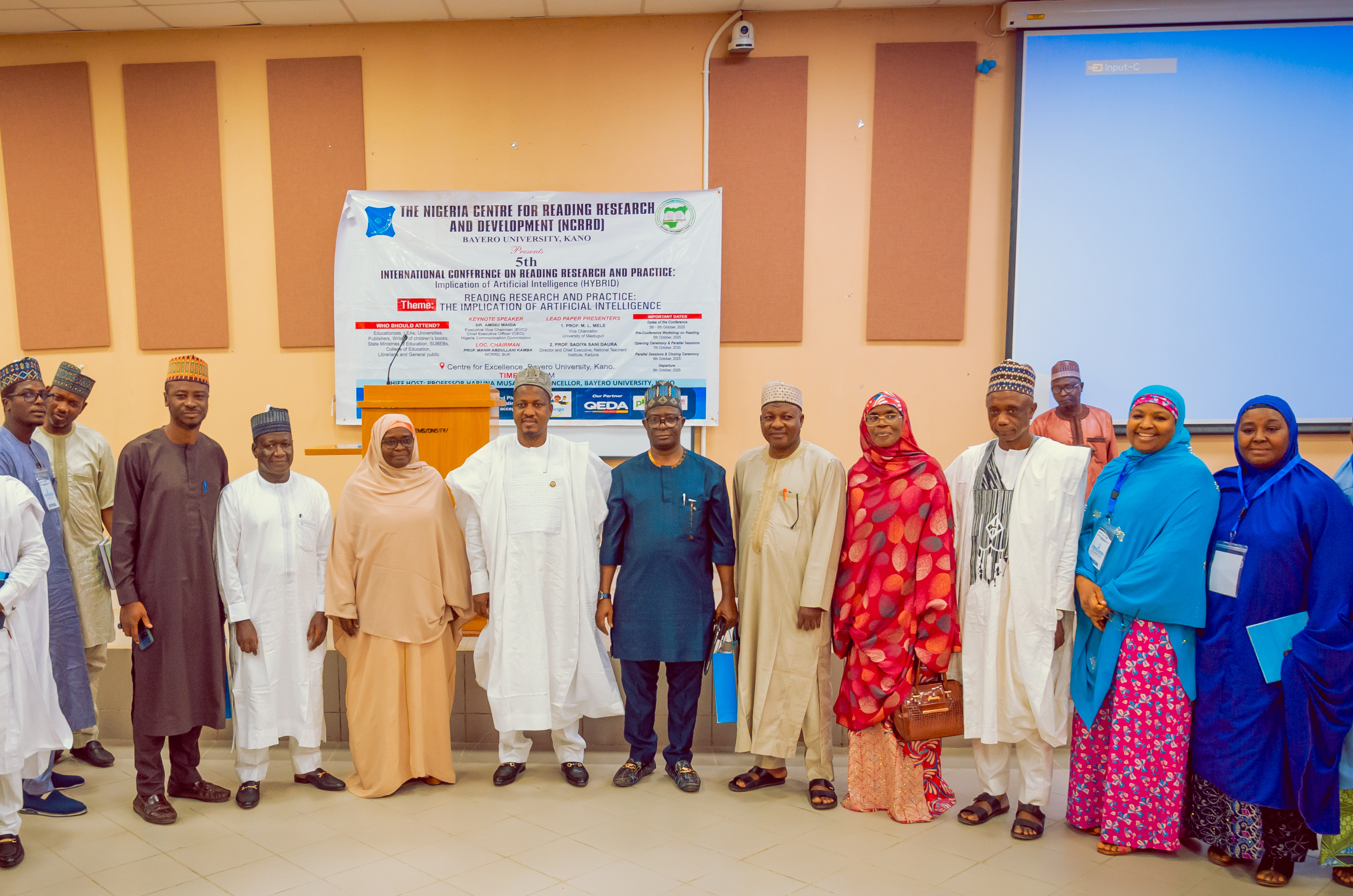
Bayero University, Kano, has hosted the 5th International Conference on Reading Research and Practice, themed “ Reading Research and Practice: The Implication of Artificial Intelligence.” The four-day event, organized by the Nigeria Centre for Reading Research and Development (NCRRD), took place from October 5 to 8, 2025, attracting scholars, researchers, policymakers and education experts.
Declaring the conference open, the Vice-Chancellor of Bayero University, Professor Haruna Musa, fsi, described Artificial Intelligence (AI) as both an opportunity and a challenge for modern education. He noted that AI is reshaping reading instruction and research by transforming how educators teach, how students learn, and how knowledge is produced and shared. The Vice-Chancellor emphasized that the conference would explore ways to integrate AI into early-grade reading instruction, particularly within Nigeria’s multilingual educational setting, and examine how digital technologies can enhance literacy and learning outcomes.
The Executive Vice Chairman of the Nigerian Communications Commission (NCC), Dr. Aminu Maida, who delivered the keynote address, highlighted the growing influence of AI in academic reading and research.
Represented by the Director Research and Development of the Commission, Ismaila Adedigba, the EVC NCC explained that AI-powered tools now assist students in summarizing complex academic materials, identifying key arguments, and improving comprehension. Recent studies, he noted, show measurable improvements in reading efficiency among students using AI-assisted platforms. However, he also drew attention to ethical questions emerging from AI use in education, including issues of authorship, data integrity and academic honesty.
Dr Maida stated that to prepare the next generation of researchers and thinkers, we must prioritize AI literacy, build local language AI models, enforce robust ethical frameworks, and ensure digital inclusion across both urban and rural spaces He said the time has come to transform Nigeria not just into a user of AI, but into a co-creator of the global AI knowledge economy.
He concluded that “this is the AI future we must shape—human-centered and inclusive, where technology becomes a bridge to shared knowledge and opportunity. This is not merely the implication of Artificial Intelligence. It is imperative.”
In the first lead paper presentation, Professor Sadiya Sani Daura, Director and Chief Executive of the National Teachers’ Institute (NTI), Kaduna, examined how AI can address persistent challenges in teaching reading in Nigeria. She pointed out that AI technologies, through adaptive learning platforms, can analyze reading patterns and offer tailored feedback that supports both teachers and learners. Her paper also underscored the need for caution in adopting AI tools, noting that poor infrastructure, limited digital literacy and ethical concerns could limit their effectiveness.
Similarly, the Vice-Chancellor of the University of Maiduguri, Professor Mohammed Laminu Mele, who presented the second lead paper, described AI as a turning point in reading education, capable of personalizing learning and improving comprehension. He, however, warned that overreliance on technology could undermine critical reading and thinking skills, stressing that AI should serve as a support tool for teachers rather than a substitute.
Earlier in her welcome address, the Director of NCRRD, Professor Amina Adamu, expressed concern over the misuse of AI among students and the lack of awareness among teachers and parents about its ethical application. She called for greater collaboration among educators, parents, and policymakers to ensure responsible use of AI in educational settings.
The conference featured expert panels, research paper presentations, and discussions on how AI can be effectively integrated into reading culture and literacy development agenda.